

HomeProductsNew arrivalsControversial Verses of the Sh...
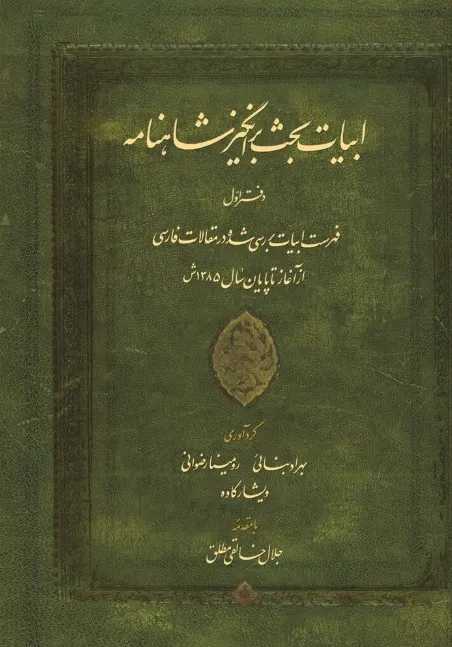
Controversial Verses of the Shahnameh
Author: Behrad Banaei, Romina Rezvani, Vishar Kaveh
Publisher: Miras Maktoob Publication
The history of publishing Persian articles on Iranian studies dates back at least to 1909 (1288 in the Iranian calendar). From the very early years, the Shahnameh was one of the most popular topics among authors, and many of its verses became subjects of scholarly debate. Therefore, compiling a list of controversial verses of the Shahnameh, with references to articles written about them, was deemed necessary. The book Controversial Verses of the Shahnameh provides a comprehensive list of those verses of the Shahnameh on which scholars of Persian language and literature, linguistics, history, mythology, and related fields have written. The book includes nearly ten thousand verses—both original and later additions—and allows researchers to see, for each verse, which Persian articles written up to 2007 (1386 SH) have discussed it.
The book, compiled by Behrad Banaei, Romina Rezvani, and Vishar Kaveh, with a preface by Jalal Khaleqi Motlagh, was published by the Institute for the Study of Written Heritage (Mo’asseseh-ye Pazhouhesh-i-ye Mirath-e Maktoub). Volume One of Controversial Verses of the Shahnameh (listing verses discussed in Persian articles from the beginning until the end of 2006/1385 SH) opens with a note by Dr. Jalal Khaleqi Motlagh. In this note, Dr. Khaleqi Motlagh writes: “Since the modern study of the Shahnameh began, the difficulty of understanding some of its verses has drawn the attention of researchers, and various opinions have been offered regarding their correction and interpretation. As research on the text and its critical editing advanced, the number of verses under discussion increased. These difficulties have various causes, which the author has experienced:
1. The absence of an original version in manuscripts examined or used so far, and possibly in all existing manuscripts;
2. The existence of multiple versions with similar meaning;
3. The difficulty of words or grammatical forms;
4. Our lack of knowledge of the poet’s perspective or related points about culture, history, court and military customs, and ancient traditions;
5. Unknown names of people and places;
6. Difficulties in meter and rhyme;
7. Spelling and script issues;
8. Apparent difficulties arising from the ‘curiosity’ of some researchers.
The importance of the present book lies in making a large number of these controversial verses, which have been subjects of scholarly debate, accessible to readers and specialists in one place. Since the location of each verse in the editor’s critical edition is also indicated, researchers can refer to it, consider variant readings, and, if necessary, examine the surrounding verses to express their opinions. Of course, among these verses there are examples that no longer pose any problem, or perhaps never did. The author expresses gratitude to the tireless efforts of the compilers, the guidance of the esteemed scholar Mr. Masoud Rasteepour, and the dedication of the Institute for the Study of Written Heritage. He is confident that other Shahnameh scholars and admirers of this monumental work share this appreciation.”
At the beginning of the book’s introduction, it is noted:
“In this book, we have attempted to collect scholarly and literary discussions regarding the verses of the Shahnameh from Persian articles published in journals, proceedings, and collections of articles up to the end of 2006 (1385 SH). Each verse under discussion, arranged alphabetically by its initial letters, is referenced to relevant research, so that researchers can easily access the history of scholarship or resolve issues related to controversial verses.”
Regarding the necessity of compiling this book, the authors explain:
“Since no flawless critical edition of Ferdowsi’s Shahnameh exists, nor a comprehensive commentary, many verses continue to be discussed, and numerous details remain unclear. Meanwhile, many points have been raised in previous articles that might be overlooked by others. Therefore, the lack of a broad index of both well-known and less-read articles—separate from Shahnameh commentaries—was felt, to make the history of these discussions available to Shahnameh scholars. Such information is otherwise only obtainable through personal note-taking.”
The book also notes:
“Two previous works—Bibliography of Ferdowsi and the Shahnameh and Descriptive-Analytical Index of Articles on Ferdowsi and the Shahnameh—fill this gap to some extent, but detailed, specialized discussions in numerous articles may still be missed or too cumbersome to review fully. Moreover, many points raised about Shahnameh verses appear in articles not primarily about Shahnameh studies, and thus are not listed in previous indexes. In the present work, all specialized and technical material across all articles has been collected in one place to provide a more accurate and comprehensive scholarly history.”
Regarding methodology, the authors state that they have: Reviewed all articles related to literature, history, culture, linguistics, ancient languages, and Iranian studies (up to the end of 2006/1385 SH) that have any connection to the Shahnameh, included every verse discussed in these articles, whether original or added later, in the book.

Reviews
There are no reviews yet.