

HomeProductsSarvestan best sellersFarangis
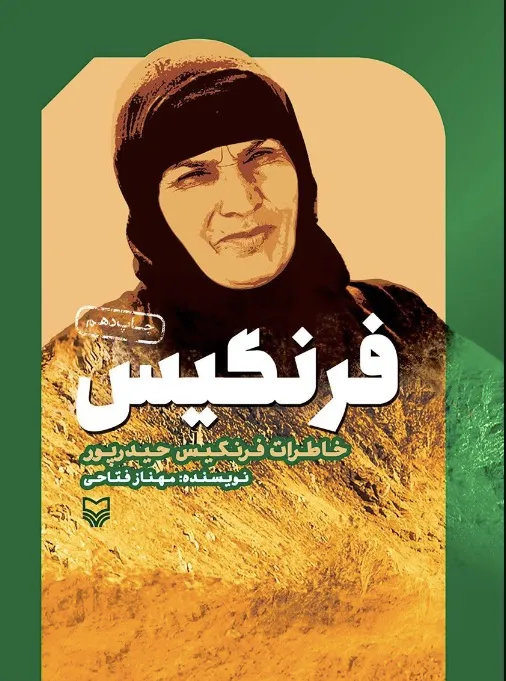
Farangis
Author: Mahnaz Fattahi
Publisher: Sooreh Mehr Publishing
Farangis is the award-winning memoir of Farangis Heydarpour, recognized as a distinguished work in the Sacred Defense Book of the Year Awards. Written by Mahnaz Fattahi, it recounts the true story of a courageous woman who, in an act of self-defense, managed to capture an enemy soldier and defeat another during the Iran–Iraq War.
Farangis Heydarpour, originally from Kermanshah, lived in a village near western Gilan. Her demeanor was even more imposing than the statue of her—holding an axe—in Kermanshah, yet she possessed a remarkably kind heart. For many years, exhausted by cameras and interviews, she refused to recount her memories. She finally agreed to share part of her wartime experiences in this book. In 1980, after Iraq attacked the village of Avazin, the locals fled to the surrounding valleys. Eighteen-year-old Farangis returned to the village at night with her father and brother to gather food. On their way, both her father and brother were killed in clashes with Iraqi forces. Soon after, Farangis encountered two Iraqi soldiers. Armed with nothing but her father’s axe, she fought them—killing one and capturing the other along with his full military gear, then delivering him to the Iranian army command.
The book is organized into 12 chapters, beginning with a preface and ending with a “Final Word.” The first chapter recalls the narrator’s childhood, a period free of war yet overshadowed by poverty and deprivation. In this chapter, she recounts an incident in which she was nearly forced to marry an Iraqi man in Khanaqin, an event prevented at the last moment by Gorgin Khan, an elder of the family. In the second chapter, a marriage proposal comes from the nearby village of Gursefid. This time, the marriage takes place, and Farangis begins her life with a man named Alimardan. The next chapters show that the young couple’s life begins happily, until the imposed war by Ba’athist Iraq begins, as detailed in chapter four. The invading Iraqi forces soon cross the border, approaching their village. Some men leave to confront the enemy, while others who go after them are all martyred. The remaining villagers flee to the surrounding mountains, where scenes of hardship, courage, and sacrifice unfold, especially from the people of Gilan-e Gharb, including Farangis and her family. In one of these scenes, when Farangis returns briefly from the mountains to retrieve food supplies from home, she encounters two Iraqi soldiers, one of whom she kills with her axe and the other she captures.
The subsequent chapters describe the repeated displacement of Farangis, her family, and other villagers. They return to the village multiple times, only to face relentless bombing, resulting in casualties and injuries, some of whom are Farangis’ own relatives. Beyond bombings, landmines also cause numerous tragedies among children and villagers. Because of the geographic location of her home, Farangis becomes witness to key events of the war, including the constant bombardment of villages around Gilan-e Gharb, the Mojahedin’s attack on Islamabad, Operation Mersad, and other unforgettable wartime incidents.
Excerpt from the book:
When I returned to the mountain, my mother and Leila were still looking at me with worry. I told myself: “It’s all right. They’ll eventually understand that what I did was right.” Avazin was in Iraqi hands, and the women constantly asked each other what to do: Should we retreat or stay? When the discussions got heated, I snapped: “We’re not leaving. We stay here. Our own forces will eventually liberate the village and we’ll return. We must endure. It won’t take long—two or three days at most.” But those two or three days became twelve. Twelve nights in the mountains of Avazin and Chaqalvand. We had only water, and sometimes we secretly went down to the village for flour to bake bread. Occasionally, our own forces would come by, visit us briefly, and leave. Once, while I was baking bread on a flat rock, several soldiers approached us from afar. I quickly stood up, my hands covered in flour. When they arrived, their commander asked: “What are you doing here? This is the front line now. Go back to Gilan-e Gharb or another village farther away. Stay here and you’ll be killed. Even we can hardly remain here—how have you managed to stay?” They couldn’t believe the villagers had remained in the war zone under such conditions. The soldiers were from northern cities and Tehran. I laughed and told them: “What, are you scared?” One of them mocked me: “Are you trying to say that you’re not afraid?” I looked him straight in the eyes and said: “No, I’m not afraid. That place you see over there—that is my home.”


Reviews
There are no reviews yet.